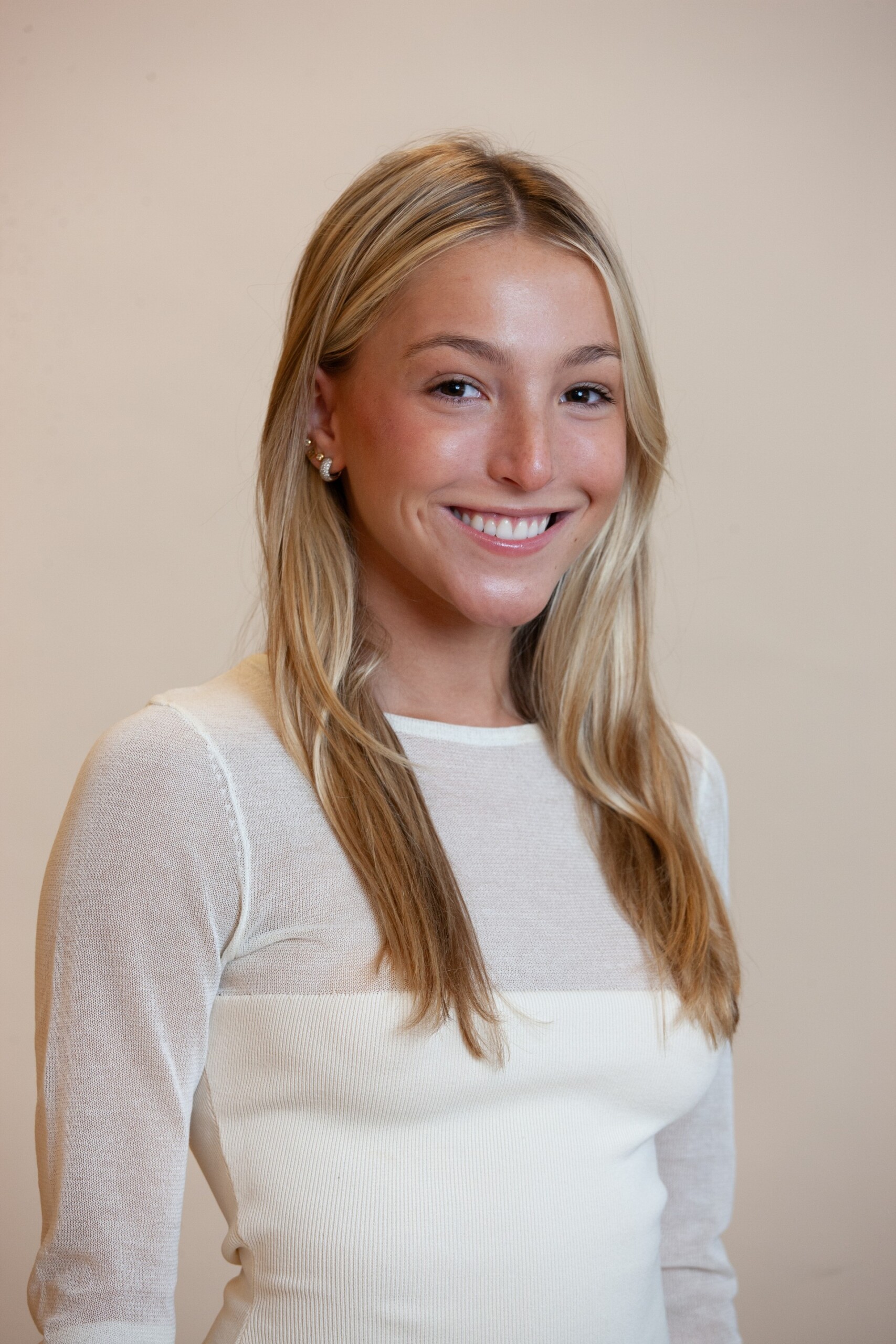
2025 SCHOLASTIC ART & WRITING FLAUNT IT AWARD WINNER. Amanda Purther, My Backwards S-Shaped Life, Personal Essay & Memoir. Grade 12, Trevor Day School, New York, NY. Gold Medal, Flaunt It Award, 2025.
My mom teared up, and my dad turned pale. They looked at me, expecting an outburst of sadness, but I sat still, unemotive.
“It’s basically a backwards S,” Dr. Widman explains, referring to my spine. He tells us the curve is on the cusp of requiring surgery and that with my rapid growth, there is no way to determineits progression. Of all the possible complications he listed, I suspect it was the potential for difficulty breathing or interference with my lungs that silenced both my parents. In the cold exam room, we learned that my only option was to wear a brace for three years—18 hours a day—designed to force my spinal curve into a straight line.
My lack of concern about the daunting process was not out of ignorance; I simply felt unchanged. I looked into the full-length mirror and saw nothing wrong. My hair had not grown drastically, my eyes were just as brown as the day before, and I still had a birth mark on my neck. Yes, if I twisted around, I could spot the crooked outline of my spine, and if I bent over, I could see my shoulder blade unevenly jutting out. But where my parents saw years of discomfort and an unknown outcome, I saw a journey I simply had to go through if I wanted a healthy future.
Of course, some aspects of wearing the brace were difficult. The discomfort made my beloved walk to school impossible, and I hated having to sit out of kickball during PE. In those moments, I appreciated the empathy of those who understood my frustration and even seemed to expect me to feel it more strongly. But ultimately, I was determined to not let my brace, diagnosis, and pain define me. Every night, I completed my assigned stretches—a routine nearly as uncomfortable as wearing the brace itself. Ignoring its clearly defined silhouette visible in every outfit, I continued to dress in my favorite form-fitting clothes, holding my head high. While the brace’s hard plastic and velcro straps dug into my skin, interrupting almost every night’s sleep, I never missed a sleepover, during which my scoliosis was never a topic of conversation.
That summer, my parents were skeptical about sending me to camp, but I never thought twice about attending. Just as I’d predicted, my friends were accepting of my condition; they even named my brace “Beatrice.” Years later, I worked as a counselor, hoping to instill the same positivity and openness I’d felt in my bunk into younger campers. It only took one night as a staff member to recognize that most of my campers had their own Beatrices: celiac disease, peanut allergies, ADHD, anxiety, and more. While some were nonchalant about their conditions, others like Brynn— who suffered from asthma—came to me in tears. After a particularly bad attack, Brynn was nervous about who’d witnessed the, as she put it, “humiliating” event. Eager to share my mindset with Brynn, I walked her to the bathroom mirror, asking her to describe what she saw. Together we noted her eyes were, in fact, still green, her hair still strawberry blonde, and her freckles still sprinkled in the same places. We smiled as Brynn recognized herself no different from the day before. Her lack of change confirmed that she was always going to be Brynn, with or without her asthma.
It’s been two years since my final night with Beatrice. My shoulder blade still juts out ever so subtly, and my back aches when I’m seated for too long, but I am grateful for my backwards Sspine. Not only did it reveal my own inner strength and resilience, but it gave me an opportunity to relay those innate qualities to others experiencing similar obstacles.